By Haley Arnold
Every year vast areas of land are deforested. At the same time, some previously deforested areas regrow - either as naturally regenerating “secondary forests” or as plantations [1,2]. Long-standing patterns of forest losses and gains have led to an increase in secondary and plantation forests relative to old “primary” forests which have been undisturbed for centuries.
Parallel to this shift in forest cover, the species found within forests are changing rapidly over time. The species that make up forest communities fluctuates naturally as forests recover over time, as well as with to human activities (eg. when species are introduced to new areas, when a species is driven to local extinction or when populations move to avoid disturbances or changes in climate).
Parallel to this shift in forest cover, the species found within forests are changing rapidly over time. The species that make up forest communities fluctuates naturally as forests recover over time, as well as with to human activities (eg. when species are introduced to new areas, when a species is driven to local extinction or when populations move to avoid disturbances or changes in climate).
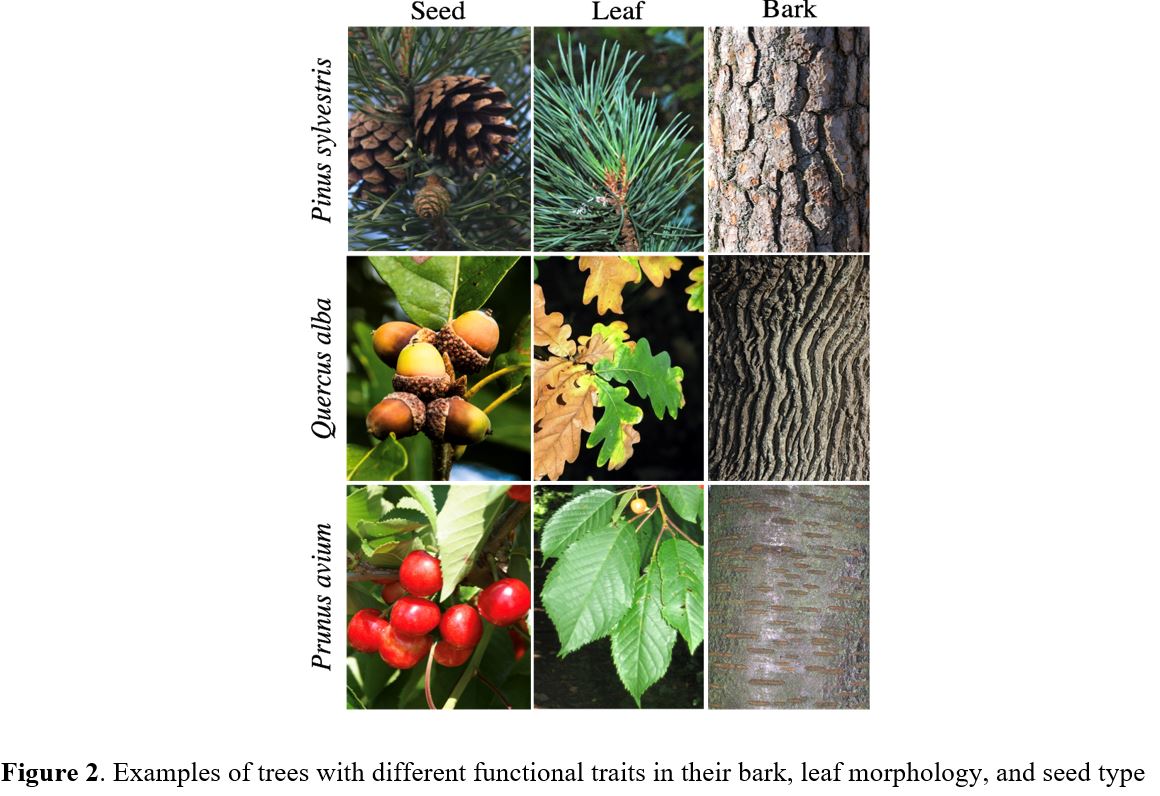
Trees are key taxa in forest ecosystems. Trees provide physical three-dimensional structures, food resources and microclimates which other plants and animals can use. The trees which make up a forest community greatly influence the type and quality of habitat available within a forest. Each tree species has different traits which influence how an individual interacts with other organisms and their environment. For example, some trees produce fruits and flowers which are valuable food resources for fruit- and nectar-eating animals, some have deeply furrowed bark which can house invertebrates, and some have sturdy limbs which can support epiphytic plants or provide secure nesting locations.
Since each species has a unique set of traits, changes in which tree species inhabit a forest can affect which resources are available, and when. Shifts in the types of trees which make up a forest can therefore change the type and quality of habitat available.
I am conducting a research project to investigate how tree biodiversity changes in naturally regenerating secondary forests over time, and how these changes affect the ability of forests to sustain other plants and animals.
Since each species has a unique set of traits, changes in which tree species inhabit a forest can affect which resources are available, and when. Shifts in the types of trees which make up a forest can therefore change the type and quality of habitat available.
I am conducting a research project to investigate how tree biodiversity changes in naturally regenerating secondary forests over time, and how these changes affect the ability of forests to sustain other plants and animals.
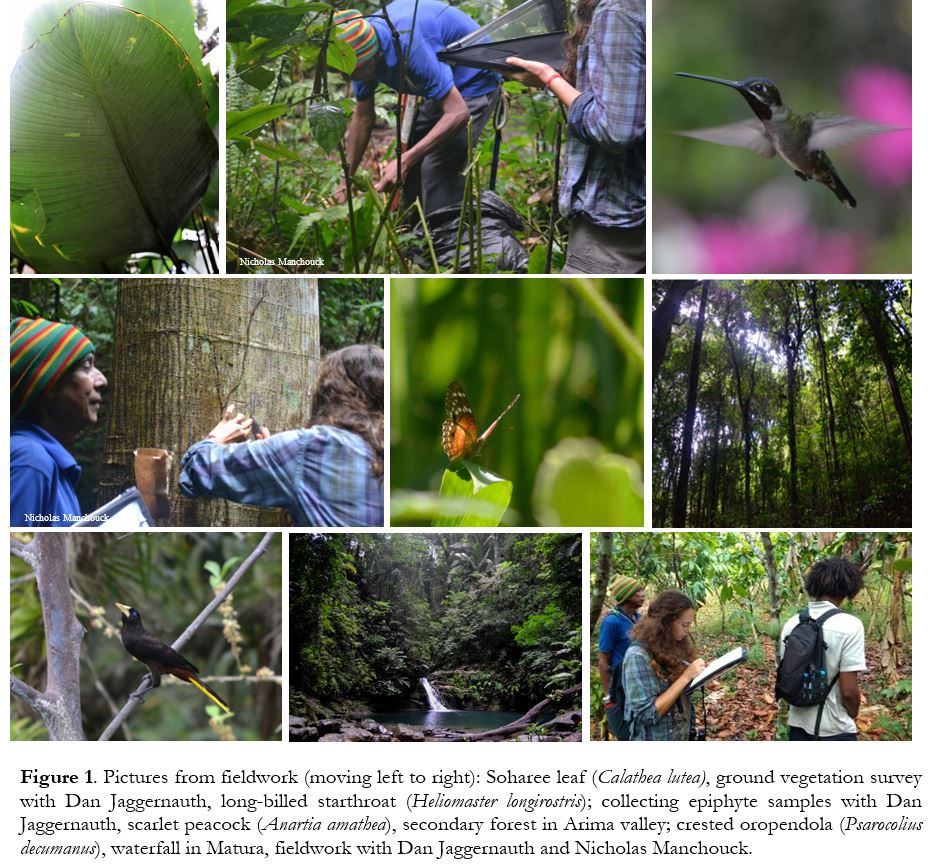
To answer my question, my field team and I survey active and abandoned cocoa plantations scattered throughout the seasonal evergreen forests of Trinidad’s Northern Range. The study sites represent cocoa plantation forests at different ages and stages of secondary forest regeneration (a process called “succession”). Trinidad is the ideal location for this research due to its long history of cocoa farming, and the sequential periods in Trinidad’s history where cocoa farming became less lucrative leading to labour shortages and causing many estates to be abandoned [3]. These cocoa forests provide an excellent model of forest regeneration, from active plantations to those abandoned over 100 years ago, where forest age since abandonment can be used as a proxy for time.
In each forest patch we survey the tree, ground vegetation, tree trunk dwelling epiphyte, bird and butterfly communities as well as some environmental variables including canopy cover and land gradient. These taxonomic groups were chosen because they represent different levels of the food chain, and different abilities to move and spread. These taxa are also commonly used as indicators of ecosystem well-being since species often have known tolerances to different types of disturbance.
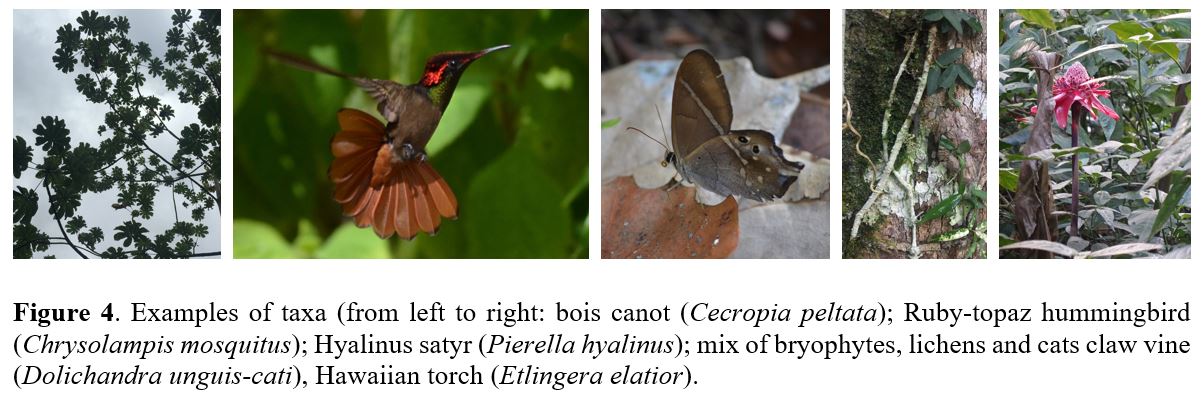
Using these data, I will look at how tree biodiversity changes over time, and compare whether trends of change within the tree community are reflected within the other plant and animal communities. I hypothesise that changes in which tree species inhabit a forest will be linked with changes in forest biodiversity, and especially with the range and types of traits represented by the community. I further hypothesis that trends of biodiversity change over time within the tree community will be reflected in the other taxonomic groups.
I also conducted a parallel study in timber plantation forests in Fife, Scotland and will supplement this research by analysing data from the BioTIME biodiversity time series database [4].
With this research, I hope to better understand how changes in the tree community affect the habitat and conservation value of forests, as well as the relationship between species, species’ traits and habitat quality. In this way, I hope to gain some further insight into how the ongoing rapid changes in forest cover and forest communities will affect the ability of forests to provide habitat and act as biodiversity reservoirs.
Citations
1. Global Forest Watch. Tree Cover Loss (2015). Available at: www.globalforestwatch.org.
2. FAO. The global forest resources assessment. FAO For. 44 (2015).
3. Bekele, F. L. The History of Cocoa Production in Trinidad and Tobago. Proc. APASTT Semin. 4–12 (2004).
4. Dornelas, M. et al. BioTIME: A database of biodiversity time series for the anthropocene. Glob. Ecol. Biogeogr. 0, 1–26 (2018).
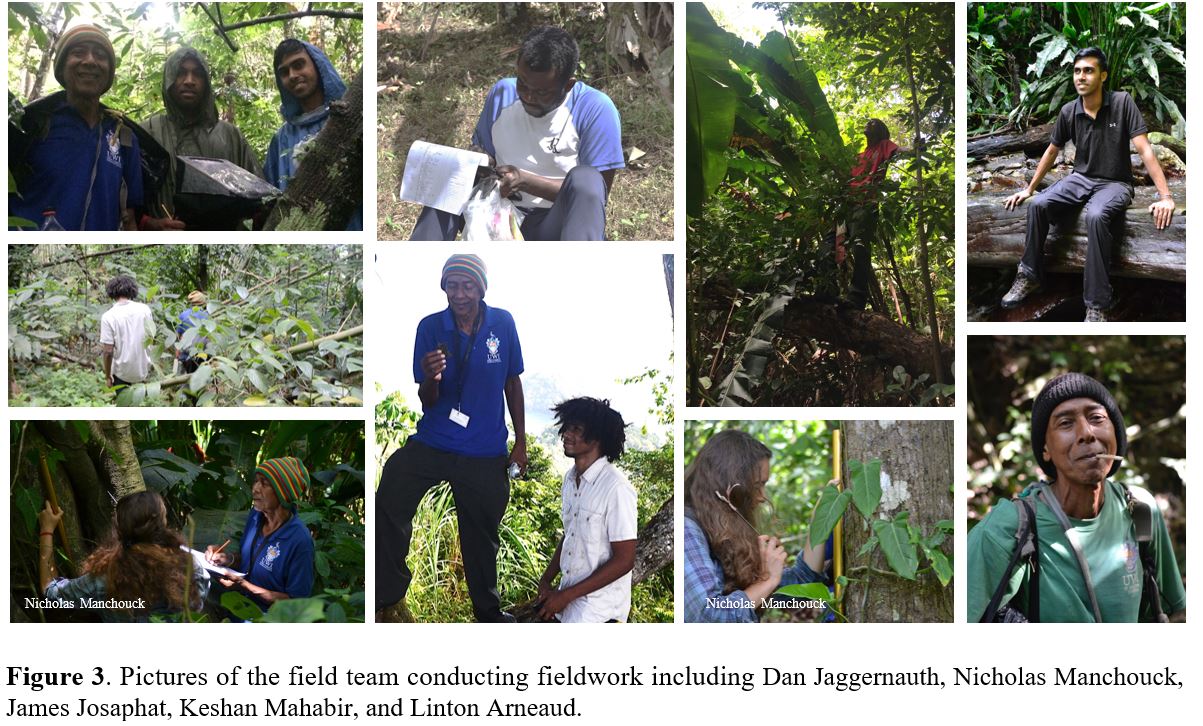
Field team: Dan Jaggernauth, Nicholas Manchouck, James Josaphat, Keshan Mahabir, Dr Amy Deacon, Dr Aidan Farrell, Dr Mark Hulme, Dr Alex Sansom, Ada Fontrodona Eslava, Linton Arneaud, Vicki Balfour, Shane Ballah
I also conducted a parallel study in timber plantation forests in Fife, Scotland and will supplement this research by analysing data from the BioTIME biodiversity time series database [4].
With this research, I hope to better understand how changes in the tree community affect the habitat and conservation value of forests, as well as the relationship between species, species’ traits and habitat quality. In this way, I hope to gain some further insight into how the ongoing rapid changes in forest cover and forest communities will affect the ability of forests to provide habitat and act as biodiversity reservoirs.
Citations
1. Global Forest Watch. Tree Cover Loss (2015). Available at: www.globalforestwatch.org.
2. FAO. The global forest resources assessment. FAO For. 44 (2015).
3. Bekele, F. L. The History of Cocoa Production in Trinidad and Tobago. Proc. APASTT Semin. 4–12 (2004).
4. Dornelas, M. et al. BioTIME: A database of biodiversity time series for the anthropocene. Glob. Ecol. Biogeogr. 0, 1–26 (2018).
Field team: Dan Jaggernauth, Nicholas Manchouck, James Josaphat, Keshan Mahabir, Dr Amy Deacon, Dr Aidan Farrell, Dr Mark Hulme, Dr Alex Sansom, Ada Fontrodona Eslava, Linton Arneaud, Vicki Balfour, Shane Ballah
Haley Arnold is a PhD student at the University of St Andrews, supervised by Prof Anne Magurran (St Andrews) and Dr Amy Deacon (The University of the West Indies). Haley spent a year at the Department of Life Sciences, The University of the West Indies St Augustine Campus (2018-2019) as a visiting student while she conducted this fieldwork.
 RSS Feed
