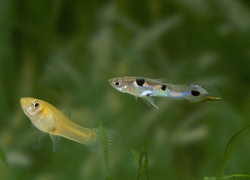
 Female guppies usually mate multiply
 Researchers at the University of St Andrews have made a shock discovery; that restricting a normally multiply mating fish to monogamous mating does not impair their colonisation ability. Their findings show that releasing just one or two fish into the wild may be enough to trigger an aquatic invasion.
In a paper published this month in the journal BMC Ecology, researchers from the University of St Andrews tested whether forcing female guppies to be monogamous would impede their ability to establish viable populations.
The guppy (Poecilia reticulata) is a successful invasive species throughout the tropics. In the wild it employs a 'multiple mating' strategy, and resulting broods commonly contain offspring sired by up to five different fathers.
Previous studies have shown that mating with multiple partners carries a range of benefits, including increased genetic and phenotypic diversity of offspring, and inbreeding avoidance -which are potentially advantageous for a species attempting to colonise a new environment.
However, as part of this latest study, female guppies were either allowed to mate with four males, or were restricted to one partner. Pregnant females were then left to establish populations in large tanks in the laboratory. After one year, the two treatments were compared.
Dr Amy Deacon explains:
"One of our key findings was that mating history did not predict establishment success, which was 88% in both treatments".
In a paper published this month in the journal BMC Ecology, researchers from the University of St Andrews tested whether forcing female guppies to be monogamous would impede their ability to establish viable populations.
The guppy (Poecilia reticulata) is a successful invasive species throughout the tropics. In the wild it employs a 'multiple mating' strategy, and resulting broods commonly contain offspring sired by up to five different fathers.
Previous studies have shown that mating with multiple partners carries a range of benefits, including increased genetic and phenotypic diversity of offspring, and inbreeding avoidance -which are potentially advantageous for a species attempting to colonise a new environment.
However, as part of this latest study, female guppies were either allowed to mate with four males, or were restricted to one partner. Pregnant females were then left to establish populations in large tanks in the laboratory. After one year, the two treatments were compared.
Dr Amy Deacon explains:
"One of our key findings was that mating history did not predict establishment success, which was 88% in both treatments".
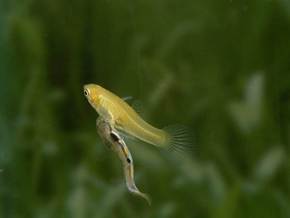 A monogamous pair of guppies.
 What's more the researchers had expected that inbreeding depression might be evident in the behaviour of fish in the monogamous treatment, which would suggest that their ability to persist once established could be limited. However, this was not the case; newborn and adult male offspring of both treatments were equally good at avoiding predators and at courting females.
These results suggest that even when denied the option of multiple mating, singly-mated female guppies can produce viable populations, at least at the founder stage.
The ability to colonise even when multiple mating is restricted may prove to be critical during introductions, where a few individuals are released into enclosed water bodies before finding their way into natural ecosystems. For example, guppies are commonly introduced into rivers or ponds as unwanted pets, or into troughs or wells for mosquito control, but later tend to spread to new habitats during floods or monsoons.
Once established in rivers and streams, aquatic invaders are notoriously difficult to eradicate.
The findings of this study reinforce the message that although seemingly harmless, releasing just one or two individuals can lead to a potentially invasive population.
The full text (open access) article can be viewed at: http://www.biomedcentral.com/1472-6785/14/18
Authored by me, this press released was edited and issued by the University of St Andrews Press Office.
Coverage in the media includes:
http://www.heraldscotland.com/news/home-news/scientists-discover-that-monogamy-does-not-curb-colonisation-by-guppies.24607524
http://phys.org/news/2014-06-invasion-monogamous-fish.html
http://cryptozoologynews.blogspot.com/2014/06/invasion-of-monogamous-fish.html
These results suggest that even when denied the option of multiple mating, singly-mated female guppies can produce viable populations, at least at the founder stage.
The ability to colonise even when multiple mating is restricted may prove to be critical during introductions, where a few individuals are released into enclosed water bodies before finding their way into natural ecosystems. For example, guppies are commonly introduced into rivers or ponds as unwanted pets, or into troughs or wells for mosquito control, but later tend to spread to new habitats during floods or monsoons.
Once established in rivers and streams, aquatic invaders are notoriously difficult to eradicate.
The findings of this study reinforce the message that although seemingly harmless, releasing just one or two individuals can lead to a potentially invasive population.
The full text (open access) article can be viewed at: http://www.biomedcentral.com/1472-6785/14/18
Authored by me, this press released was edited and issued by the University of St Andrews Press Office.
Coverage in the media includes:
http://www.heraldscotland.com/news/home-news/scientists-discover-that-monogamy-does-not-curb-colonisation-by-guppies.24607524
http://phys.org/news/2014-06-invasion-monogamous-fish.html
http://cryptozoologynews.blogspot.com/2014/06/invasion-of-monogamous-fish.html



 RSS Feed
